Ringtone Anxiety: How Desi Parents Turned FaceTime Into the New Guilt Trip Hotline
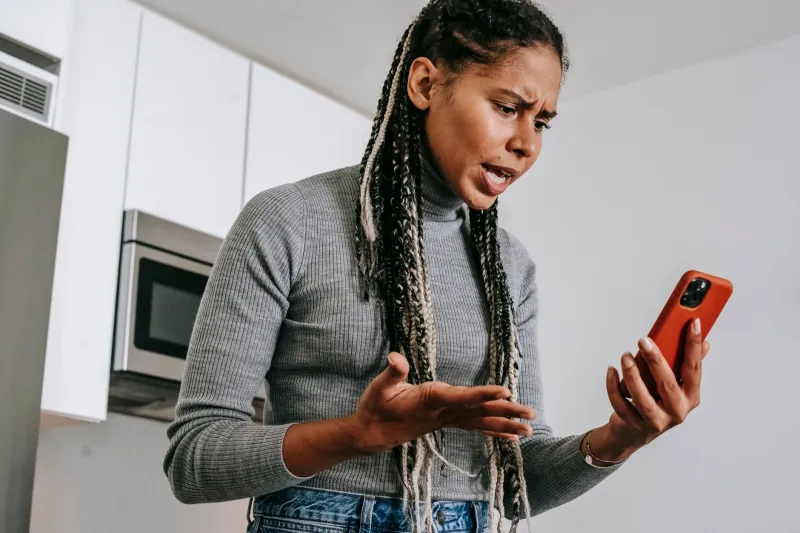
There's a specific kind of dread that settles in when your phone lights up at 8:47 a.m. on a Tuesday. Not a text. Not a voicemail. A FaceTime call. And you already know — before you even see the contact name — that you have approximately four seconds to decide whether you're emotionally available enough to perform being a good child.
For millions of South Asian Americans living far from their parents' homes, this is just Tuesday. Or Wednesday. Or honestly, most days ending in Y.
Technology was supposed to make the distance easier. And in some ways, it did. But somewhere between the invention of WhatsApp groups and the normalization of location sharing, it also handed an entirely new generation of Desi parents a surveillance toolkit they never had before — and they've learned to use it fluently.
When "Just Checking In" Becomes a Full-Time Job
Nehaa Krishnamurthy, a 29-year-old software engineer in Austin, Texas, describes her daily communication routine with her parents in Chennai as "a second shift I never clocked into voluntarily."
"It started with one FaceTime a day," she says. "Then it became two. Then my mom found out you could see when someone was last active on WhatsApp, and suddenly every response delay became a whole conversation about whether I was ignoring her."
The expectation isn't just contact — it's visible contact. The video call, specifically, has become a kind of proof of life for Desi parents navigating the anxiety of an ocean between them and their children. But therapists who work with South Asian diaspora communities say the emotional math rarely adds up in the adult child's favor.
"What looks like love from the outside often functions like surveillance on the inside," says Dr. Priya Menon, a licensed therapist based in the San Francisco Bay Area who specializes in South Asian family dynamics. "The child learns early that connection is contingent on performance. You have to look okay. You have to sound happy. You have to be available. And if you're not, the guilt that follows is engineered to feel like your failure, not theirs."
The Performance of Gratitude
There's a script most diaspora adults know by heart. It goes something like: appear on camera looking rested (even if you're not), mention something you ate that your parents would approve of, ask about relatives you've never met, and under no circumstances bring up anything that would worry them — which is basically anything real about your life.
For Arjun Sethi, a 34-year-old marketing director in Chicago, the performance became so exhausting that he started scheduling his parents' calls the way he'd schedule a work meeting — with a prep window and a recovery window.
"I'd give myself fifteen minutes before to get into the right headspace, and then like twenty minutes after just to decompress," he says, laughing a little at how absurd it sounds out loud. "My therapist pointed out that I was treating a call with my own parents like a client presentation. That kind of broke something open for me."
The emotional labor of these calls — the careful curation of what to share, what to hide, how to modulate tone so as not to trigger concern or criticism — is something therapists are seeing show up more and more in sessions with South Asian clients.
"The concept of 'emotional tax' is real here," says Dr. Menon. "These adults are paying a psychological toll every single time they pick up the phone. And because the love is genuine — they do love their parents — they feel tremendous shame about the resentment that builds up alongside it."
Location Sharing and the New Leash
If FaceTime is the guilt trip, location sharing is the ankle monitor.
It started, for many families, as a practical safety measure. A daughter moving to a new city. A son doing late-night commutes. Reasonable, even loving, in origin. But somewhere along the way, it became a live feed that parents refresh the way some people refresh their Twitter.
"My mom once called me because she could see I was at a restaurant and she wanted to know who I was with," says Meera Iyer, 27, a grad student in Boston. "I hadn't even sat down yet."
The expectation of access — to location, to schedule, to emotional state — is something younger Desi Americans are increasingly pushing back against, even if the pushback itself generates its own wave of guilt. Turning off location sharing, declining a call, or — heaven forbid — setting a boundary around call frequency, often triggers a response that feels disproportionate: tears, silence, the dreaded "I just wanted to hear your voice," delivered in a tone that makes you feel like a monster for wanting a Tuesday to yourself.
Generational Trauma, Transmitted in HD
What makes this complicated — and what therapists are careful to name — is that the behavior isn't malicious. It's inherited.
Many Desi parents grew up in households where emotional expression was limited, where love was demonstrated through sacrifice and proximity, and where the idea of a child living independently thousands of miles away would have been unthinkable. The anxiety they feel about distance isn't manufactured. It's real, and it's rooted in a cultural framework where family closeness literally equaled survival.
"When we talk about guilt-tripping, we have to hold space for the fact that these parents are also operating from their own unprocessed fears," says Dr. Menon. "They weren't given the language for 'I miss you and I'm scared.' So it comes out as control. As surveillance. As 'why didn't you call me back for three hours.'"
That doesn't make it easier to live with. But it does reframe what's actually being transmitted through the screen — not just guilt, but unresolved grief, cultural dislocation, and the fear of becoming irrelevant in their own children's lives.
Finding the Off Button
More Desi Americans in their twenties and thirties are now entering therapy specifically to work through family communication dynamics — a trend therapists say has accelerated sharply since the pandemic, when the lines between connection and enmeshment blurred for everyone.
The work, they say, rarely involves cutting parents off. It involves something harder: renegotiating the relationship without dismantling it.
"I had to have a real conversation with my parents about what I could and couldn't give," says Arjun. "It went badly at first. My mom cried. My dad gave me the silent treatment for a week. But on the other side of it, something shifted. They still call a lot. But it feels different now. Less like a check-in, more like they actually want to talk to me."
Nehaa says she's still in the middle of it. "I haven't figured it out yet," she admits. "But I stopped answering every call the second it comes in. That felt like a tiny revolution."
For a generation raised to equate responsiveness with love, ignoring a FaceTime might be the most radical act of self-preservation available. And maybe that's exactly the point.