When Your Kid Starts Quoting Therapy at You: The Generational Flip Reshaping Desi Households

Something quietly seismic is happening at Desi dinner tables across America. The children who once nodded through lectures about sacrifice, duty, and the price of a plane ticket from Hyderabad are now the ones doing the talking — and they're armed with a vocabulary their parents never saw coming.
Attachment styles. Emotional unavailability. Generational trauma. Boundaries.
If you're a South Asian American between the ages of 22 and 35, there's a solid chance you've used at least one of those phrases in a conversation with your parents in the last year. And if you're a Desi parent in America right now, there's an equally solid chance you've stared at your child like they just announced they were joining a cult.
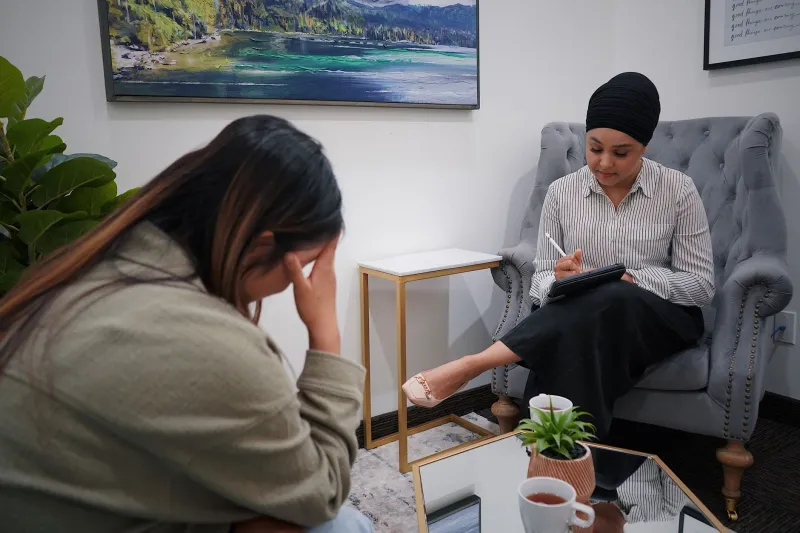
Welcome to the new Desi family dynamic — where the kids have become the counselors, and nobody signed up for this.
The Therapy Pipeline Nobody Planned For
It didn't happen overnight. It happened in the slow accumulation of college counseling sessions, Instagram infographics, TikTok therapists with ring lights, and a global pandemic that forced everyone to sit with themselves a little too long.
For South Asian Americans specifically, the access to mental health language arrived at a particular cultural crossroads. Many grew up in households where emotions were managed through silence, stoicism, or a well-timed plate of food. Feelings weren't processed — they were redirected. You got good grades. You moved on.
Then this generation discovered that there were actual words for what they'd been experiencing. Words like "emotional suppression" and "parentification" and "anxious attachment." And once you have the language, you can't un-have it. You start seeing patterns everywhere — including, inevitably, at home.
"I remember the first time I told my mom she was being emotionally dismissive," says Priya, a 27-year-old in New Jersey whose parents immigrated from Tamil Nadu. "She looked at me like I had personally insulted every ancestor she'd ever had. Then she went and made me chai. Which, honestly, is kind of the whole point."
Hilarious, Heartbreaking, and Very Much Real
The moments that come with this role reversal are equal parts comedy and complexity.
There's the classic scenario of a Desi twenty-something gently explaining to their father that his communication style might be "avoidant" — and the father responding that he built an entire life from nothing and doesn't need a word invented by Americans to explain how he loves his family. Fair point, honestly.
There's the group chat where siblings coordinate before a family call, debating whether to address the elephant in the room or just let it sit there eating metaphorical samosas. There's the cousin who went to therapy for six months and now cannot stop diagnosing every family gathering like she's presenting a case study.
But underneath the humor is something genuinely tender. These young adults aren't trying to dismantle their parents. They're trying to understand them — and in doing so, trying to understand themselves. The therapy language isn't a weapon. For most, it's more like a flashlight in a room that's been dark for a very long time.
"My dad grew up in a household where his own father never said 'I love you' once," says Rohan, a 30-year-old software engineer in the Bay Area. "He doesn't know how to say it either. But I've started just... naming it. Saying, 'I know you show love by working hard and providing.' And something shifted. He started hugging me when I leave. Small thing. Everything."
The Cultural Tug-of-War
It's worth being honest about the friction here, because there's plenty of it.
Desi parents — particularly first-generation immigrants — carry a weight that therapy language sometimes flattens. They navigated immigration, economic precarity, cultural displacement, and the pressure of raising children in a country that didn't always make space for them. Telling someone who survived all of that that they need to "work on their emotional regulation" can land as dismissive, even when it's well-intentioned.
And American individualism — the philosophical backbone of so much therapy culture — doesn't always translate cleanly into collectivist family structures where the group's wellbeing takes precedence over any one person's feelings. The idea that you should "set a boundary" with your mother can feel genuinely alien to a parent who sacrificed everything precisely because they didn't believe in putting themselves first.
This is the real tension: not just a generational gap, but a values gap. And navigating it requires more than a TikTok about narcissistic parents.
"I had to learn to hold both things," says Meera, a therapist herself, based in Chicago, whose family is originally from Gujarat. "My parents' way of expressing love is real and valid. And also, some of the patterns I grew up with caused me harm. Both of those things are true. The work is figuring out how to honor one without denying the other."
Something New Is Being Built
Here's what's easy to miss in all the discourse: this generational flip isn't just about conflict. In many Desi households, it's quietly producing something that didn't exist before — actual conversation.
Parents who once deflected emotional topics are starting to ask questions. Not always comfortably, not always gracefully, but asking. Children who spent years performing okayness are starting to tell the truth. Families that communicated primarily through obligation are discovering they can also communicate through curiosity.
It's slow. It's imperfect. Sometimes it ends with someone storming off to call their aunt in Chennai. But it's happening.
The Desi American experience has always been about translation — translating cultures, translating identities, translating what it means to belong somewhere in between. This generation is just doing a new kind of translation work. They're finding words for things their families felt but never named, and then — carefully, imperfectly, lovingly — handing those words back.
Maybe that's what healing looks like in a diaspora household. Not a breakthrough moment. Not a dramatic confrontation. Just a kid sitting across from their parent, saying: I see you. I'm trying to understand. And I'm not going anywhere.
Even if it takes a hundred awkward conversations and an equal number of cups of chai to get there.